
.svg)








The rules regarding accessibility for people with disabilities in public-access buildings (ERP) have recently undergone regulatory changes. Let's review these changes that affect you as an ERP operator.
I. What is an ERP?
Public-access buildings (ERP) are defined as: "all buildings, premises, and enclosures in which people are admitted, either freely or for a fee or any form of contribution, or in which meetings are held that are open to anyone or by invitation, whether paid or not."
ERPs are therefore buildings where outside individuals are admitted. A business that is not open to the public, but only to staff, is not an ERP.
ERPs are subject to a dual classification system:
- by type, according to the nature of their operations (shopping centers, conference halls, banks, etc.).
- by category, based on the maximum capacity of the public and staff, ranked from 1 to 5 in decreasing order of size.
Note that for 5th-category establishments, the number of non-public personnel is not taken into account for classification.
Establishments in categories 1 through 4 are subject to stricter safety regulations than those in category 5.
ERPs must be accessible to people with disabilities, regardless of the nature of their disability.
II. A new requirement: the public accessibility register
Every operator of a public-access building (ERP) is now required to maintain a public accessibility register. This register must be made available to the public no later than October 22, 2017, and must be updated regularly. It outlines the measures taken to ensure that everyone, including people with disabilities, regardless of the nature of their disability, can access the establishment's services.
A decree dated April 19, 2017 [1] specifies the content of the public accessibility register and the procedures for making it available to the public. It also defines the specific requirements for this register regarding public transport stops that fall under the ERP regulations.
The public accessibility register must contain:
- comprehensive information on the services provided at the establishment (car parking, access to the building, available equipment such as audio guides, subtitle activation, etc.)
- a description of training programs for staff responsible for assisting people with disabilities, along with supporting documentation. For category 1 to 4 ERPs, this must include a certificate signed and updated annually by the employer detailing these training activities.
- administrative and technical documents, or copies thereof, relating to the accessibility of the establishment for people with disabilities.
These documents are as follows:
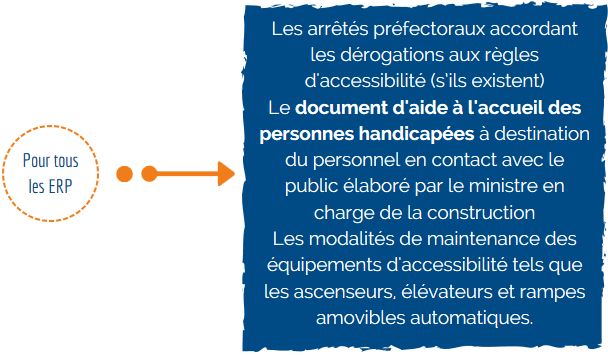
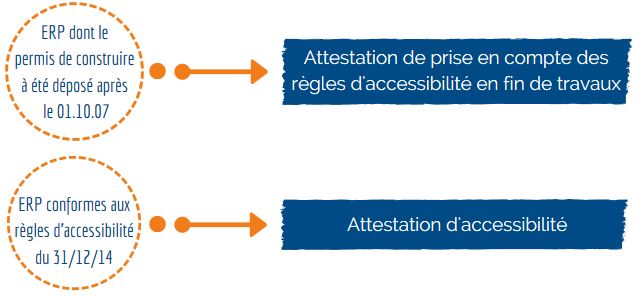
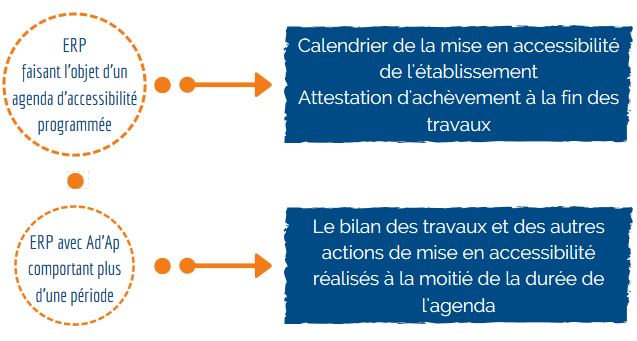
Reception staff must be able to inform users about how to access the various services offered by the establishment.
The public accessibility register must be kept available to the public at the establishment's main accessible reception point. It may be in paper or digital format (e.g., for consultation via a tablet). The register may also be published online on the establishment's website.
III. Amendments to certain accessibility rules applicable to existing ERPs
A decree dated April 28, 2017, amends the decree of December 8, 2014 [2] which sets out the accessibility requirements for existing public-access buildings (ERPs).
As a reminder, these are the accessibility rules that must be taken into account when bringing an existing ERP into compliance as part of a Programmed Accessibility Agenda (Ad'AP). The Ad'AP is a commitment to carry out accessibility improvement works in accordance with regulations. A timeline is established, and both the work and funding are scheduled.
Option to implement alternative solutions
If solutions other than those prescribed by the decree of December 8, 2014 are implemented, they must achieve the same objective. To implement these solutions, the project owner must demonstrate that they meet accessibility objectives using the following procedure:
- Submission of supporting documentation to the departmental prefect in triplicate, unless submitted electronically, prior to the start of work.
- Notification of the prefect's reasoned decision within 3 months of receiving the documentation, following consultation with the departmental consultative commission for safety and accessibility. If the commission does not respond within 2 months of receiving the request for an opinion, the opinion is deemed favorable. If the prefect does not respond within 3 months of the date the request for approval was received, approval is deemed granted.
IV. Construction of public-access buildings (ERP): new accessibility rules effective from July 1st , 2017
A decree dated April 20, 2017 [3] establishes the technical rules for ensuring the accessibility of new establishments. It repeals and replaces the decree of August 1st , 2006. These new provisions apply to applications for:
- building permits
- authorizations to build, renovate, or modify a public-access building (ERP) filed on or after July 1, 2017
Accessibility rules cover the following elements:
- exterior pathways, parking, and access to the establishment or facility
- public reception areas
- horizontal and vertical interior circulation
- stairs, elevators, moving walkways, escalators, and mechanical ramps
- floor, wall, and ceiling coverings, doors, doorways, and airlocks
- areas open to the public, equipment, and control devices
- restrooms, exits, and lighting
For each element, the expected uses and minimum specifications are detailed (e.g., signage and guidance, dimensional characteristics, location, quantity, etc.).
Additional rules are defined for:
- establishments with seated public areas (performance venues, restaurants, etc.),
- establishments with accommodation facilities (hotels, boarding schools, etc.),
- individual cabins and spaces,
- payment counters,
- devices or equipment arranged in banks or series.
Please note that solutions with an equivalent effect may be implemented. These must meet the same objectives as the solutions prescribed by the order. The project owner must then submit to the departmental prefect the information required to verify that accessibility objectives are met. This must be done before work begins. The procedure is the same as that for existing ERPs (see III. above).
Conclusion
Whether you operate an existing or future public-access establishment, these changes to accessibility rules apply to you.
As mentioned above, it is still possible to implement equivalent solutions. However, these must meet the same accessibility objective as that prescribed by the regulations.
[1] Order of April 19, 2017, establishing the content and procedures for the distribution and updating of the public accessibility register [JORF of April 22, 2017]
[2] Order of December 8, 2014, establishing the provisions for the application of articles R. 111-19-7 to R. 111-19-11 of the Construction and Housing Code and article 14 of Decree No. 2006-555 regarding accessibility for disabled persons in existing public-access establishments and existing facilities open to the public
[3] Order of April 20, 2017, regarding accessibility for disabled persons in public-access establishments during their construction and in facilities open to the public during their development [JORF of April 26, 2017]